
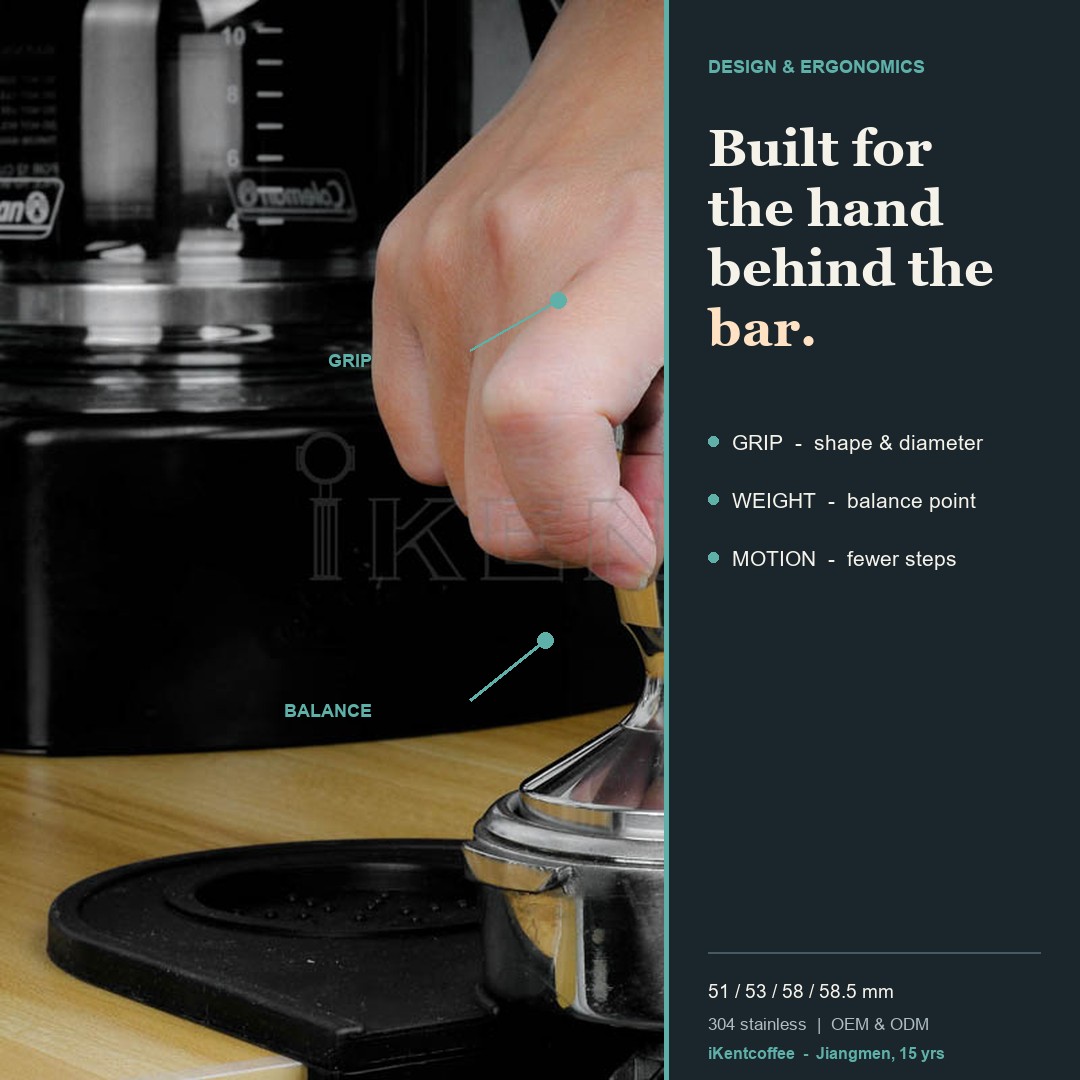
The user experience of barista equipment is mostly decided by three things you can feel but rarely see in a spec sheet: how a tool sits in the hand, how much force it asks for, and how few movements a shift demands. A tamper that fits the palm, a knock box at the right height and a milk pitcher with a balanced handle remove hundreds of small decisions a day. Good UX here is not a screen or an app – it is geometry, mass and finish chosen around the person using the tool. iKent has made these hand tools in Jiangmen for 15 years, and this guide explains what ergonomic design actually changes on a coffee bar.
What does “UX design” mean for barista equipment?
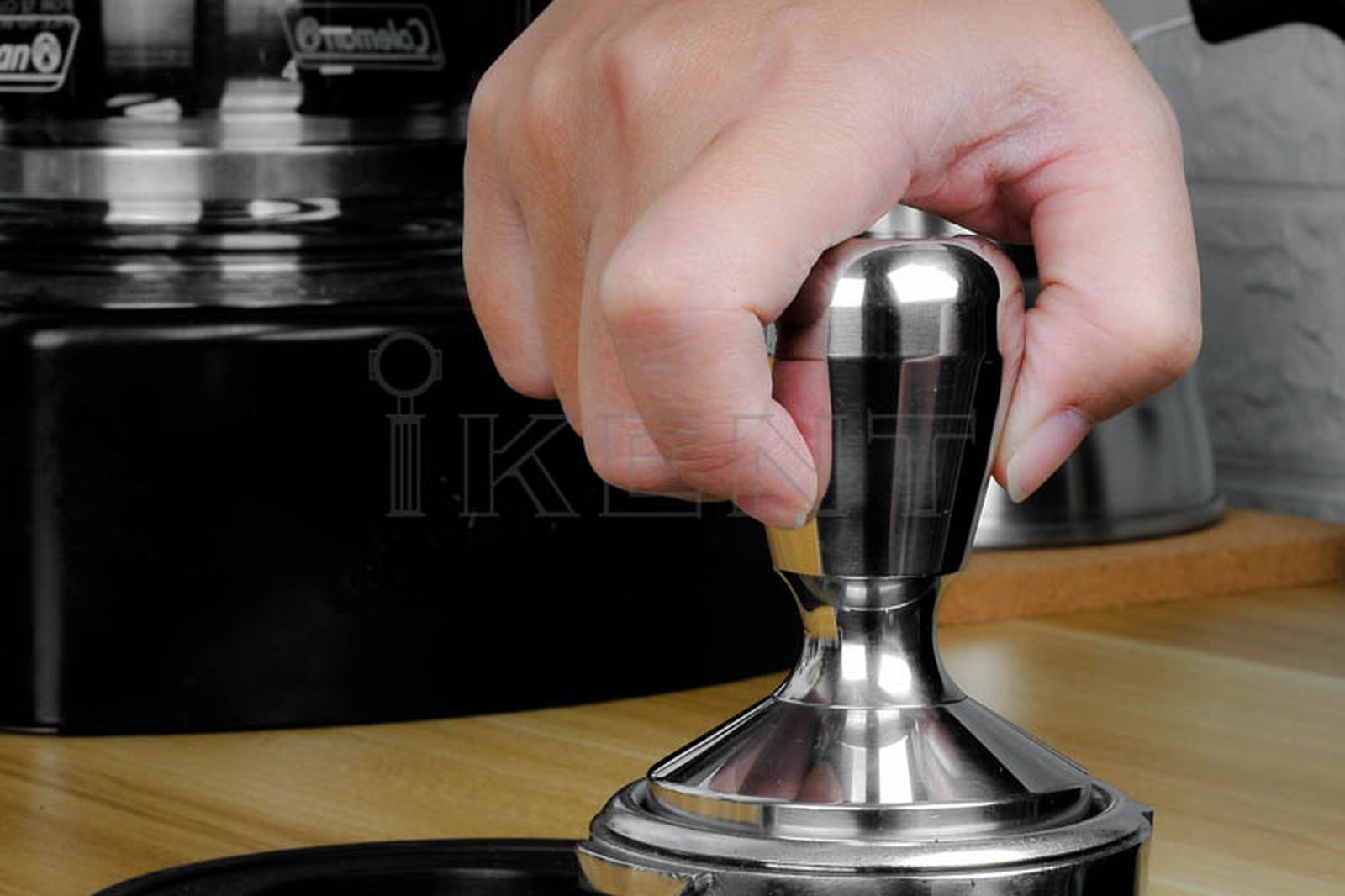
For a coffee machine, UX often means a touchscreen. For the hand tools a barista touches every minute, UX means something older and simpler: does the shape fit the hand, does the weight help or fight the motion, and can the tool be cleaned without a struggle. Ergonomics is the part of UX you can measure – grip diameter, handle length, balance point, surface texture, and the number of steps between one shot and the next.
That distinction matters because most buying guides list dimensions and materials but never describe how a tool feels after the two-hundredth repetition. A barista may pull 200 to 300 shots in a busy shift. Each one involves dosing, distributing, tamping, knocking and steaming. A few extra centimetres of reach or a handle that forces the wrist to bend adds up across those repetitions, which is why ergonomic design is a throughput and retention question, not a comfort luxury.
Why does the tamper matter so much to the hand?
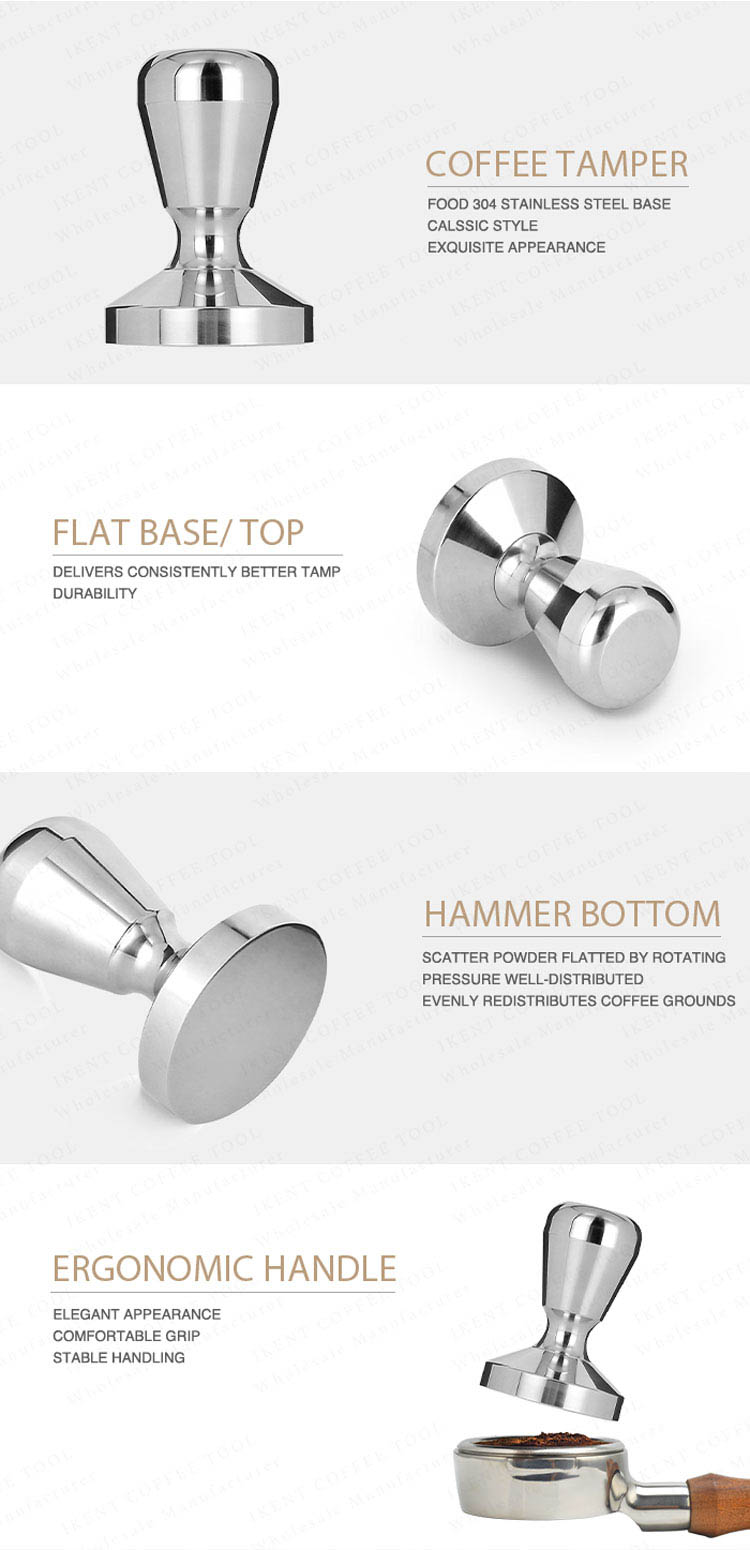
The tamper is the most repeated grip on the bar. Its job is simple – compress the puck level and firm – but the interface between palm and handle decides whether that happens consistently. A handle shaped to fill the palm spreads force across a larger area, so less grip strength is needed to hold a level press. A narrow or flat handle concentrates pressure on a few points and the hand tires faster.
Diameter is the first variable. Tamper bases come in 51 mm, 53 mm, 58 mm and 58.5 mm to match different basket sizes, and the handle above them can be tuned independently. Weighing the balance point is the second: a head-heavy tamper does some of the work for you, while a balanced one asks the wrist to supply more control. Surface finish changes the feel too. A mirror-polished handle is smooth but slippery when hands are wet; a matt or brushed finish gives more grip. Our guide to choosing a calibrated espresso tamper goes deeper on base sizes and flat versus convex faces.
How do weight and balance change the motion?
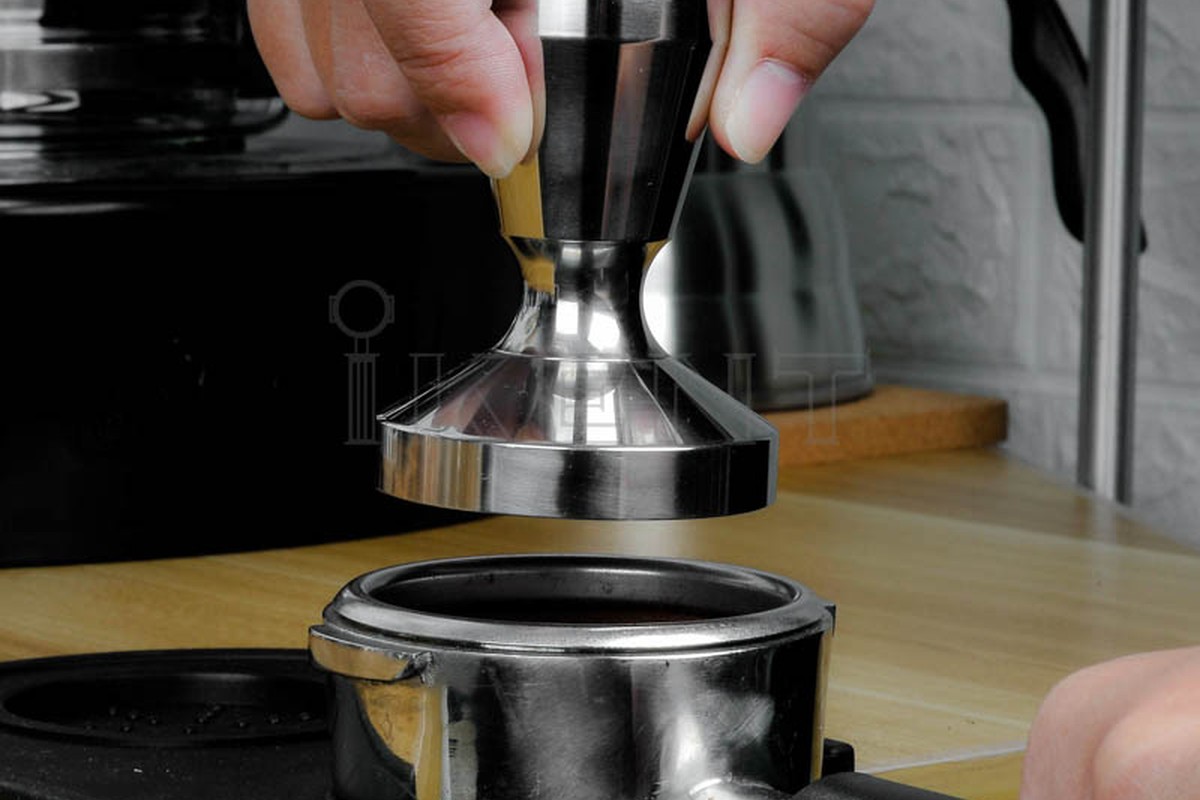
Mass is a design input, not an accident. A heavier tamper can use its own weight to compress the puck, reducing the peak force the arm must produce. That helps consistency because the barista is guiding a weight rather than pushing hard. The trade-off is fatigue over a long shift and less fine control for small hands, so there is no single correct weight – there is a weight that suits a given workflow and operator.
The same logic applies to milk pitchers. A pitcher that is heavy when empty and poorly balanced tilts the wrist during pouring, which shows up in latte art. A handle positioned so the fingers stay relaxed, with the mass centred under the grip, makes a steady pour easier. Stainless steel helps here: at roughly 8 g per cubic centimetre it is dense enough to feel solid in a small form, and it can be formed into thin walls so the weight stays manageable. Our milk pitcher selection guide covers capacity and spout shape, which are the other half of the pouring equation.
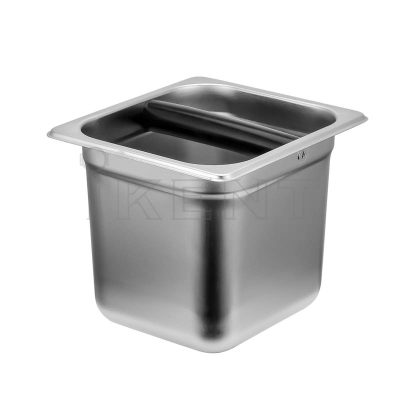
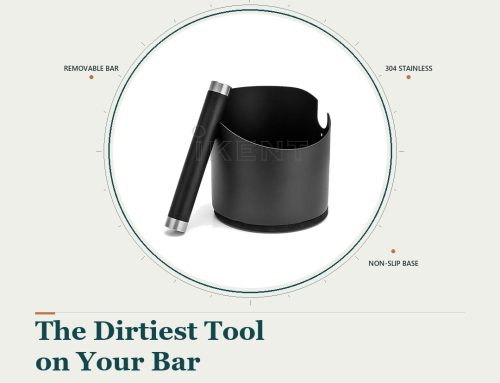
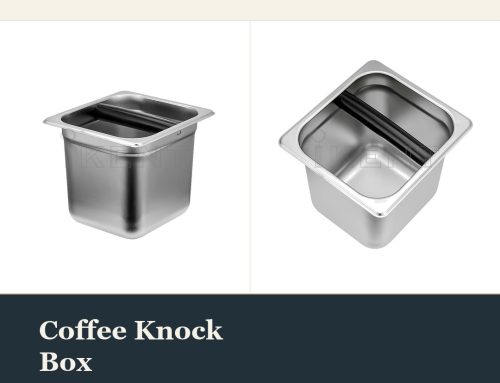
Fixed tools have the same problem in reverse: their height is set once and every motion has to adapt to it. A knock box placed too low makes the barista bend at the wrist on every knock; one placed too high forces the arm to lift. Our knock box sizing guide explains the trade-off between footprint and depth. The CKB006S, for example, uses the same 176 mm by 165 mm base in a 100 mm and a 150 mm height, so the rim can be matched to the height of the group head rather than the other way round. Across a shift of 200 shots, keeping that rim within a short reach is worth more than any single finishing detail.
Can good design reduce the number of steps?
Yes, and this is where ergonomics turns into speed. Every extra tool on the bar is an extra reach and an extra place to put something down. Distribution tools illustrate the point. A barista can tap the portafilter, use a needle tool, and then tamp – three movements – or combine distribution and levelling into one pass before tamping. Fewer separate tools mean less clutter and a shorter, more repeatable routine.
There is a real trade-off. Combination tools ask the operator to accept one fixed geometry, while separate tools let each step be tuned. Busy bars tend to favour fewer steps; experiment-driven roasters often prefer separate tools. Understanding the choice is easier with a comparison of WDT tools, levelers and calibrated tampers. The ergonomic principle is the same either way: keep the working sequence linear and put each tool where the hand already is.
What should you specify when ordering ergonomic tools?
Five variables are worth putting in writing before a production run: handle shape and diameter, total weight and balance point, surface finish, the height of fixed tools such as a knock box, and the finish under the logo. The last one is easy to miss. On a dark powder-coated surface, laser marking burns through the coating and exposes the steel, so the mark reads a different colour from the body. We silkscreen the dark version or mark before coating. A supplier who has never made the part cannot answer that question.
Below is the specification we quote against for the hand-tool range. It is a useful checklist even if you source elsewhere. Material choices start with food-grade 304 stainless steel; the reasoning is set out in our 304 stainless steel explainer.
| Ergonomic variable | What can be specified |
|---|---|
| Handle shape & diameter | Contoured or straight; diameter tuned to the palm, custom on request |
| Base size | 51 mm, 53 mm, 58 mm, 58.5 mm; custom sizes available |
| Surface finish | Mirror / matt / frosting / painting; matt and brushed give more grip |
| Body material | 304 stainless steel, food-grade; bamboo or wood handle options |
| Logo method | Laser marking or silkscreen, chosen to suit the finish |
| Sample lead time | 3–5 working days for existing models |
| Production lead time | 30 days standard / 45 days with custom logo, colour or packaging |
| Testing | Conforms to FDA (21 CFR) and LFGB; third-party report for the tested SKU |
Frequently asked questions
Is a heavier tamper always better for the wrist?
No. A heavier head supplies more downward force for less effort, which helps consistency, but it also adds load over a long shift and can be harder to control for smaller hands. The right weight depends on the operator and the number of shots per day. Test the balance in the hand before committing to a run.
Which finish gives the best grip?
Matt, brushed and frosting finishes hold the hand better than a mirror polish, especially when fingers are wet. Mirror is easy to clean and looks sharp but is the slipperiest option. Finish also decides the logo method, so choose the two together.
Can a factory change the handle shape, not just the logo?
Yes. We are a factory with two plants in Jiangmen – one for stainless steel forming and polishing, one for machining handles, springs and burrs – with 15 years in coffee tools. Handle diameter and contour can be adjusted on existing tools or developed as custom tooling, then checked as a sample before production.
What is the minimum order for an ergonomic custom tool?
Minimums are quoted per project because they depend on the part, the finish and the packaging. We keep MOQ low and small first runs are possible. Send the target quantity and the specification and we will confirm what is realistic on that tooling. A printed retail box is a separate run starting at 500 pcs.
How quickly can a grip design be checked in the hand?
Existing models can be sampled in 3–5 working days, so a handle shape or finish can be felt before a 30-day production run begins. That sample step is the point at which ergonomic decisions should be confirmed, because feel is hard to judge from a drawing.
Can the tools match a café’s interior and brand?
Yes. Colours can be matched to any Pantone, finishes run from mirror to painting, and the logo goes on by laser or silkscreen depending on the surface. A coordinated range keeps the same grip language across tamper, pitcher and knock box. See our coffee tools branding guide for the options.
Tools to start with

Browse the full iKent Coffee Products range for sizes, finishes and OEM options.
Let’s Build Something Together
The coffee world keeps demanding quality, functional accessories. Partner with iKentcoffee to offer tools that perform and represent your brand proudly. From manual coffee grinders, espresso tampers and coffee canisters to milk pitchers and full coffee sets — we provide OEM & ODM solutions with low MOQ and stable supply.
👉 Contact us today to discuss wholesale, customization, or to request a sample.
💭 Jiangmen Aika Houseware Co., LTD
💭 Jiangmen Zhenhua Hardware & Plastic Factory
We look forward to the opportunity to collaborate with you!
WhatsApp: +86 13426845305
E-mail: kaelyn@ikentcoffee.com
Website: www.ikentcoffee.com

Leave A Comment