
Accessories are the strange part of the coffee market. Machines are considered purchases – researched, compared, financed. Under roughly thirty dollars, behaviour flips entirely: these are things people add to an order without deliberation, buy again for someone else, or replace because they liked the colour. Understanding which items fall into that band, and why some keep selling while others stall, is most of what matters in this category.

What follows is less about specific products and more about the traits that separate items that move from items that sit.
The three traits that predict repeat sales
Low consideration. The purchase decision has to take seconds. Anything requiring explanation – how it fits, whether it is compatible, why it costs more than the alternative – has already lost most impulse buyers.
Immediate comprehension. The customer has to understand what it does from one image. This is why simple tools consistently outperform clever ones online: clever requires a paragraph, and paragraphs do not convert well in a thumbnail grid.
No downside risk. Nobody worries about trying a fifteen-dollar tool. That Psychological safety supports healthy conversion rates and explains why small accessories often subsidise the traffic that later sells larger items.
Why stainless dominates this category online
Material matters more in e-commerce than in a shop, because the customer cannot touch the product. Three practical reasons explain why stainless accessories perform particularly well in channels:
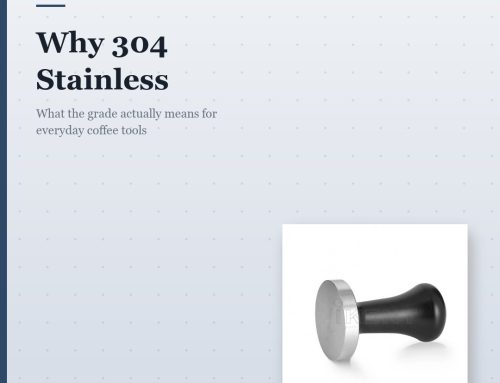
It survives the courier. Damage in transit is a direct margin loss plus a support cost plus a review risk. Metal absorbs shipping impacts that break ceramic and glass, and the difference shows up directly in return rates. Our guide to what 304 stainless actually means covers the material side in more detail.
It photographs accurately. Stainless renders predictably under ordinary lighting and reproduces its real colour on most screens. Highly reflective and translucent materials do not, which leads to the “looks different in person” reviews that damage listings.
It is dimensionally stable. Nothing shrinks, warps or degrades in a warehouse, so returns and fit complaints stay low even after long storage.
Where the category actually grows
Two kinds of accessory build long-term sales: those that solve a recurring irritation and those that complete a set.
Recurring-irritation products get bought because something annoys the buyer every morning – grounds spilling across the bench, a portafilter that will not stay clean, storage that lets beans go stale. These sell on utility and generate the most genuine reviews, because relief is easy to write about.
Set-completing products ride existing investment: somebody who already owns the grinder wants the storage that matches it. This is why finish consistency matters commercially, not just aesthetically. A range where everything shares one visual language converts browsers into multi-item baskets; a catalogue of unrelated finishes does not.
Packaging is part of the return rate
Accessories are small, which makes poor packaging disproportionately expensive. Undersized boxes arrive crushed, loose items rattle and scratch each other, and a scuffed metal surface is indistinguishable from a defective one in a customer photo.
For anything sold online, the practical rule is treat packaging as a product requirement: fit for the actual parcel journey, protection between contact surfaces, and enough structure to survive being stacked. It costs less than the returns it prevents.
What tends to stall
Items that fail usually fail for one of three reasons. They solve a problem nobody has – ingenious but pointless additions that need explaining. They need compatibility knowledge before purchase – sizes, thread standards, machine-specific fittings – which introduces hesitation and returns. Or they are too close to something the customer already owns without being clearly better.
The last one is the most common. Lots of accessories occupy the same functional space; unless something is obviously better made or better finished, the cheapest listing wins and nobody builds anything durable.
Frequently asked questions
Which coffee accessories sell best online?
Small tools that solve an obvious daily irritation and require no compatibility knowledge: dosing funnels and rings, storage that keeps beans fresh, small maintenance items. Anything the customer understands from one photograph tends to convert.
Does material choice change return rates?
Yes, significantly. Metal tolerates courier handling far better than brittle materials, and lower breakage directly reduces refunds, replacements and negative reviews – often outweighing the difference in unit cost.
How do you build repeat purchases in this category?
Make the range coherent. Matching finishes and consistent sizing turn one purchase into several, because people want things that look related on the same counter – and it makes gifting easier, which is most of the accessory volume.
Accessories that ship well


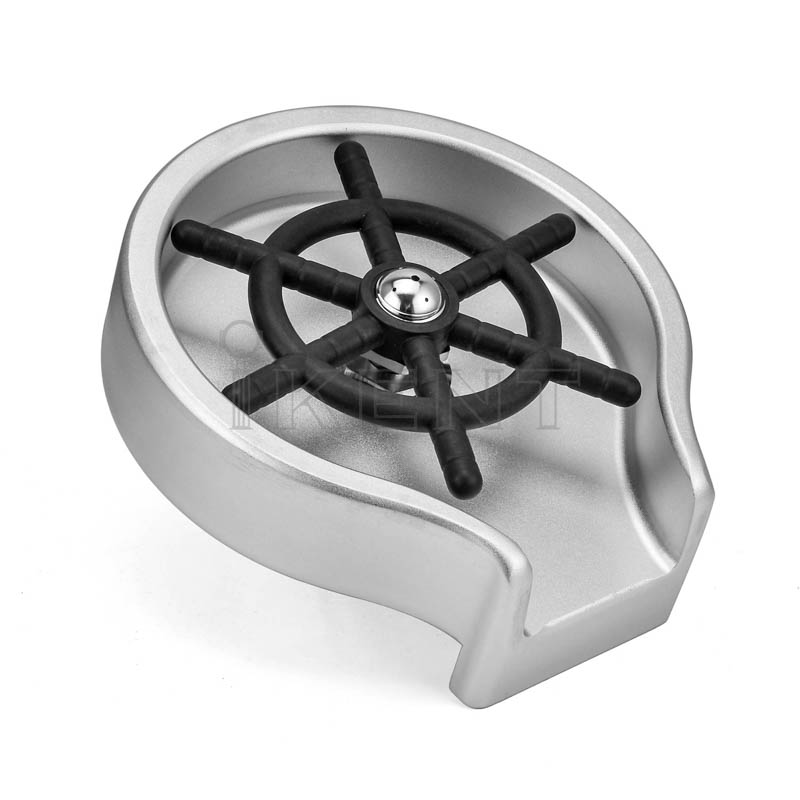
Browse the full Coffee Accessories range for sizes, finishes and OEM options.
Let’s Build Something Together
The coffee world keeps demanding quality, functional accessories. Partner with iKentcoffee to offer tools that perform and represent your brand proudly. From manual coffee grinders, espresso tampers and coffee canisters to milk pitchers and full coffee sets — we provide OEM & ODM solutions with low MOQ and stable supply.
👉 Contact us today to discuss wholesale, customization, or to request a sample.
💭 Jiangmen Aika Houseware Co., LTD
💭 Jiangmen Zhenhua Hardware & Plastic Factory
We look forward to the opportunity to collaborate with you!
WhatsApp: +86 13426845305
E-mail: kaelyn@ikentcoffee.com
Website: www.ikentcoffee.com
Leave A Comment