
A WDT tool is a small object with a disproportionately large effect on espresso. Thin needles raked through a puck of ground coffee break up clumps and level the bed, which removes most of the channelling that makes shots run unevenly. That reputation has moved it from a niche enthusiast accessory to something cafes stock and brands want to put their own name on – which is where specification starts to matter far more than most people expect.

This guide is written for buyers putting a distributor under their own brand. It covers the decisions that have to be made before quoting, because a lot of them are expensive to change after tooling.
Start with the needles, not the logo
The working end of the tool is where it succeeds or fails, and it has four variables worth pinning down early.
Count. Six to twelve is the common range. More needles cover the puck faster, but too many packed into the same circle stops them doing much beyond combing the surface.
Diameter. Thicker needles hold their shape through months of daily stirring; very thin ones bend and stay bent, which customers notice immediately. A tool that arrives bent reads as cheap whatever the bundle looks like.
Spacing. Evenly distributed across the basket diameter, reaching close to the wall. Gaps in coverage mean unlevelled patches, and an unlevelled patch is exactly what channelling needs.
Finish on the tips. Sharp enough to move coffee, not sharp enough to gouge a fingertip or catch on a portafilter. This is the sort of thing worth feeling in person on a sample rather than approving from a drawing.
Clumping is largely decided upstream, by how evenly the beans were ground – which is why the needle work builds on our notes on what makes grind consistency possible rather than replacing it.
Body material and finish
The visible parts of a distributor are doing two jobs at once: they have to survive being knocked around a bar, and they have to look like the price you need to charge. Stainless handles both. It takes daily impact, it does not hold odour, and it accepts finishes – a mirror polish for one look, brushed for another, or a spray coating or baked paint when a brand needs a specific colour to match the rest of a range. Our notes on the quiet tool trend cover why that consistency across a range sells.
Where the handle is natural wood or bamboo, remember it changes what the care instructions must say: wipe rather than soak. It is a small line in the leaflet that prevents a whole category of complaints.
Where the branding actually goes
Private label succeeds or fails on details like these, and they are usually decided far too late:
Engraving or laser marking on a stainless collar reads as permanent and tends to suit premium positioning. It survives dishwashers and daily handling with no upkeep.
Printing or pad printing allows multi-colour artwork and works well on coated finishes, but durability depends on where the mark sits – contact points and grip surfaces wear faster.
Embossed or etched plates on the top cap give a subtle effect that photographs well, though artwork possibilities are limited.
Whatever the method, check it against how the tool is actually used: this is an object people hold in a closed grip several times a shift. Branding on a surface that is always in contact with a hand will not last.
Packaging is part of the product
A distributor arrives as a loose tool in a pouch, or as something that looks like a product on a shelf – and customers read the difference before they read anything printed. For retail, a rigid box or a well-finished sleeve wins; for cafe-supply channels, neutral bulk packaging keeps per-unit cost sensible; for subscription and gift programmes, the unboxing does the work that advertising usually does.
It is also worth deciding early whether spare needle sets ship with it. A disposable-feeling accessory drags the perceived value of everything beside it.
Minimum quantities and what to sample
The realistic path is not “quote then wait”. It is: define the needle spec and finish, request samples built to that spec, and test them against your own baskets and your own grinders. Distributors behave differently depending on dose and basket shape, so a tool that performs beautifully in one setup may be mediocre in another.
Sampling is also when tolerances get validated. Repeated assembly and disassembly reveals whether the collar stays true to the body over time – something no drawing can show you.
Timelines, in plain terms
Standard configurations with existing tooling move quickly because most of the uncertainty is already resolved. Custom needle counts, unusual finishes, printed graphics or bespoke packaging each add stages: sample approval, tooling where applicable, production slot, then freight. Building that sequence into a launch plan up front is much easier than compressing it later, and none of it is avoidable for anything genuinely custom.
Frequently asked questions
What needle count should I choose for a first run?
Around eight to ten needles with even spacing suits most 58 mm baskets and most users. It is dense enough to level quickly and open enough for each needle to do real work – which is why it is a safer opening range than either extreme.
Can the finish be matched to other tools in our range?
Usually yes. Sprayed or baked finishes can be matched to reference colours, and stainless can be polished or brushed to different levels. Send physical references rather than screen colours – screens do not reproduce metal reliably.
What is a realistic minimum order?
It depends on how much is custom. Existing specifications generally require lower minimums than an original design needing new tooling. Share the intended quantities at the start and workable options can usually be found for a first run.
Distributors we make under private label

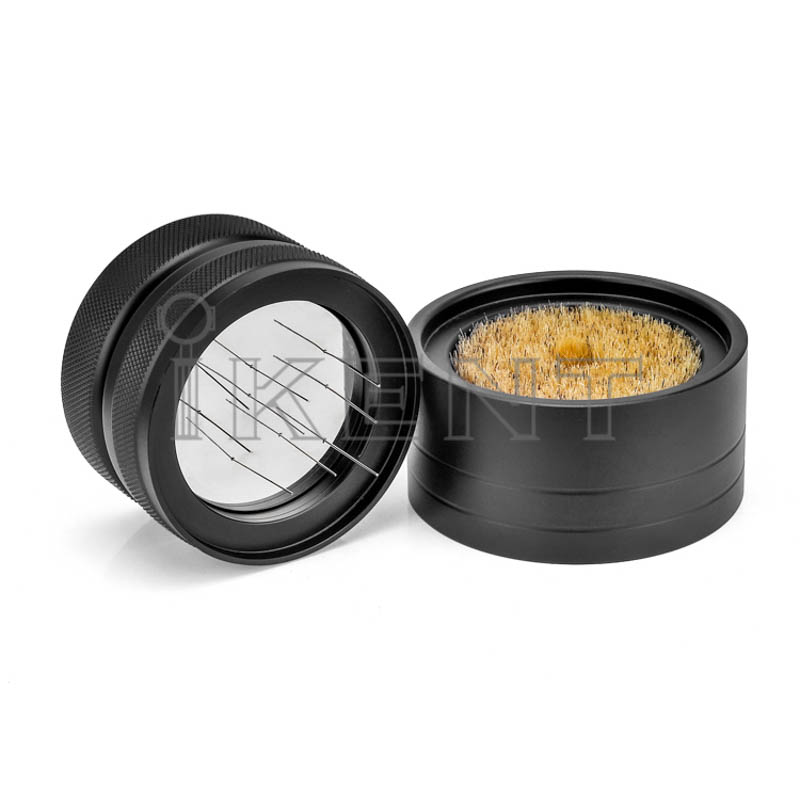

Browse the full Coffee Tamper Distribution range for sizes, finishes and OEM options.
Let’s Build Something Together
The coffee world keeps demanding quality, functional accessories. Partner with iKentcoffee to offer tools that perform and represent your brand proudly. From manual coffee grinders, espresso tampers and coffee canisters to milk pitchers and full coffee sets — we provide OEM & ODM solutions with low MOQ and stable supply.
👉 Contact us today to discuss wholesale, customization, or to request a sample.
💭 Jiangmen Aika Houseware Co., LTD
💭 Jiangmen Zhenhua Hardware & Plastic Factory
We look forward to the opportunity to collaborate with you!
WhatsApp: +86 13426845305
E-mail: kaelyn@ikentcoffee.com
Website: www.ikentcoffee.com
Leave A Comment