
Something shifted in coffee tools over the past few years, and it did not happen because the complicated options got worse. Espresso machines became more capable and more adjustable than ever, and simultaneously the accessories people actually reach for got simpler: hand grinders instead of electric ones, press pots instead of pump machines, manual tampers and distributors instead of spring-loaded calibrated ones.

The interesting question is not whether this is happening – anyone selling into the category can see it – but why, and what it means for anyone choosing products to stock or specify.
Simpler tools get used on the second morning
The strongest argument has nothing to do with aesthetics. A tool that requires setup, calibration and a familiarisation period has a real chance of being abandoned by day three. A hand grinder gets used on the second morning because there is nothing to learn except turning the handle – the same reason set out in our notes on what hand grinders do well.
Every additional step is a place for someone to stop. Descaling cycles, apps, charging cables, firmware updates, dial calibration routines – each individually reasonable, collectively the reason good equipment ends up in cupboards. Simple tools have a much higher chance of surviving contact with an ordinary weekday.
Less to break, less to maintain
Fewer parts means fewer failure modes. No motor to burn out, no seals to perish, no electronics near water and heat – which together form most of the realistic ways a coffee tool stops working. A grinder with a burr set and a bearing will outlast almost anything else in the kitchen.
This changes the ownership economics in a way that matters to buyers. A simple stainless tool is not just cheaper to buy, it is cheaper to own for ten years – no consumables beyond beans, no service interval, nothing to replace when a cable fails.
The skill ceiling moved down and the floor moved up
The quiet enabler here is that manufacturing quality improved. A mid-priced hand grinder today produces more consistent results than a much more expensive one did a decade ago, because burr machining and tolerance control got better and more widely available.
That combination – easier to use, harder to get badly wrong – is what converts beginners. The barrier to entry is now low enough that people can buy in without committing to a hobby, which expands the market rather than just shifting it.
Simple does not mean basic
This distinction matters because it is where a lot of bad product decisions get made. Simplifying should remove steps, not quality. A grinder with fewer adjustments is only better if the burr is still good. A distributor with fewer moving parts is only better if the needles are well spaced and hold their shape.
The parts that should not be simplified are the ones doing the work: burr material and alignment, seal quality in anything meant to be airtight, wall thickness and balance in anything handled daily. Simplify the interface, never the function – the whole appeal collapses the moment simplicity starts costing results.
What it changes for retailers and brands
Three practical effects are worth planning around. First, entry price matters less than perceived durability. Customers comparing two simple tools ask “which will last?”, not “which has more features” – which puts weight on material, finish and build.
Second, the simple tool is often a first purchase in a longer relationship. Someone starting with a hand grinder eventually adds storage, a scale, a brewer. Ranges that share one design language capture those follow-on purchases; disconnected catalogues do not.
Third, the story has to be honest. “Simple” becomes a weakness if the product cannot explain what it does well. Saying a tool relies on steel burrs and a fixed grind range is a reason; saying it is “easy to use” is not.
Where complexity still earns its place
There are real cases. High-volume settings genuinely benefit from electric grinders because effort and time outweigh maintenance. Precise repeatability for espresso favours fine, stable adjustment over anything simpler. Temperature-sensitive methods justify kettles with control. None of that has gone away.
The trend is not toward cheapest-possible equipment. It is toward matching complexity to the job – and recognising that most people’s actual job on a Tuesday morning is one good cup, quickly, without maintaining anything.
Frequently asked questions
Is simpler equipment better for beginners?
Usually. Fewer steps between intention and drinking means fewer opportunities to be discouraged. The caveat is that a very cheap simple tool is worse than a good complex one – the simplification should remove friction, not quality.
Do simple tools produce worse coffee?
Not inherently. A good steel burr set beats a blade mechanism regardless of what powers it, and many simple manual tools outperform mid-range electric ones at the same price, because the money went into the working parts.
Does this trend mean people are spending less?
Not necessarily – they are spending differently. Buyers will pay more for something built to last than for something with more functions, which is why materials and finish carry more weight in this category than feature lists do.
Simple tools that stay in use


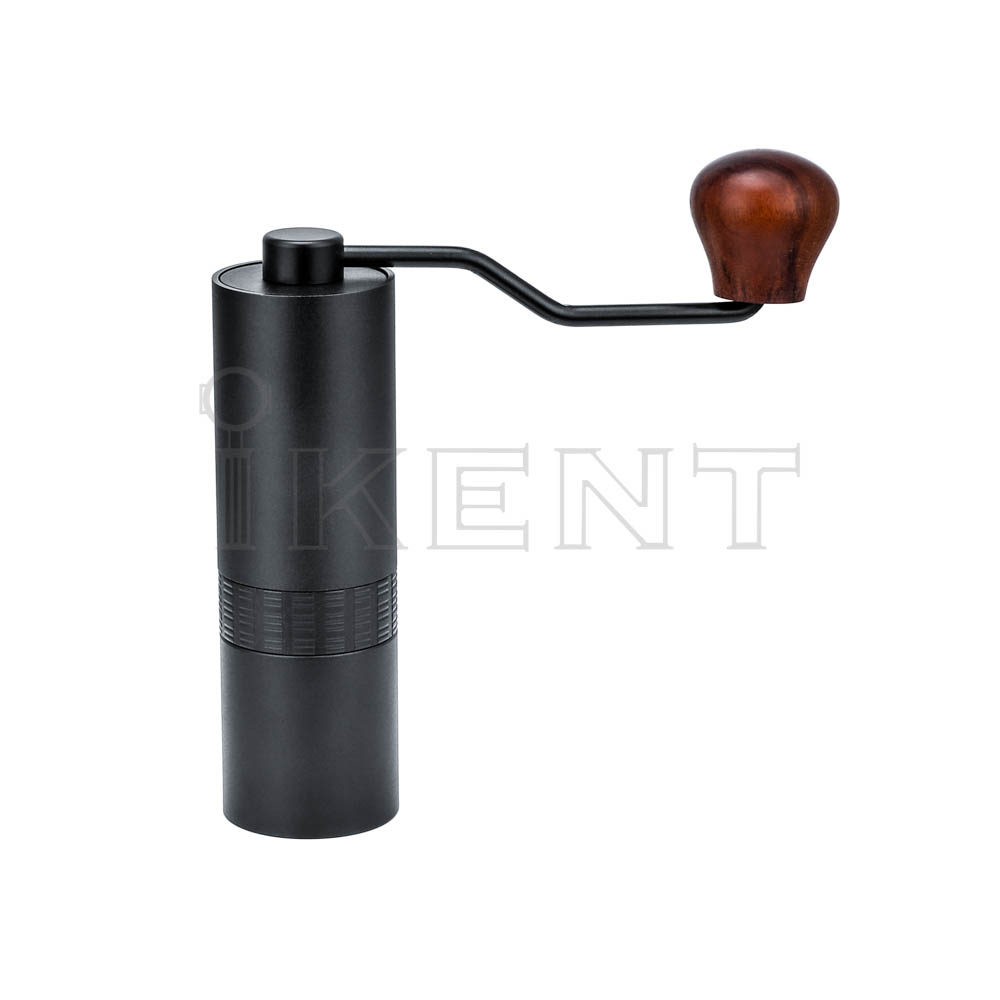
Browse the full Coffee Tamper Distribution range for sizes, finishes and OEM options.
Let’s Build Something Together
The coffee world keeps demanding quality, functional accessories. Partner with iKentcoffee to offer tools that perform and represent your brand proudly. From manual coffee grinders, espresso tampers and coffee canisters to milk pitchers and full coffee sets — we provide OEM & ODM solutions with low MOQ and stable supply.
👉 Contact us today to discuss wholesale, customization, or to request a sample.
💭 Jiangmen Aika Houseware Co., LTD
💭 Jiangmen Zhenhua Hardware & Plastic Factory
We look forward to the opportunity to collaborate with you!
WhatsApp: +86 13426845305
E-mail: kaelyn@ikentcoffee.com
Website: www.ikentcoffee.com
Leave A Comment