
A storage canister looks like the simplest product in a coffee range – one body, one lid – until you try to specify one. Everything that determines whether it works long-term is hidden inside tolerances: how thick the gasket is, how the lid seats, whether the finish survives handling. Those details are also the ones that are expensive to change once tooling exists.

This is written for anyone preparing to place an OEM or private-label order, in roughly the order decisions need to be made.
Body material: start with what is defensible
Food-grade stainless – normally 304 – answers most requirements at once. It blocks light completely, which matters because light accelerates staling; it is non-porous, so it will not carry flavour between batches; it survives shipping and daily handling; and documentation for food contact is straightforward.
Coated interiors exist, but they introduce a question that has to be answered per batch rather than per product line: is the coating itself food-safe for direct contact with something that will sit inside for months? Uncoated food-grade steel avoids that conversation entirely and is usually the cleaner specification.
Written material declarations should be requested as standard practice. Retailers increasingly ask for this at onboarding rather than at first order, and suppliers who can produce it per batch are the ones worth building around.
Sealing: the part that decides whether it works
A canister succeeds or fails at the closure. Three options come up repeatedly:
Silicone gasket with a press or screw lid. The most reliable everyday solution, provided the ring runs the full circumference and compresses evenly. Silicone keeps resilience through thousands of opens, while cheaper foam takes compression set and stops sealing.
One-press or clamp lids. Very convenient and strongly sealed early in life, but hinge and latch mechanisms add parts that can fail. If this style is chosen, cycle-test the closing mechanism repeatedly on samples.
Valve-fitted lids for fresh-roasted beans releasing CO2. Genuinely useful for that one case, and unnecessary for ground coffee, tea or powder, where the priority is keeping air out rather than letting it escape.
Capacity structure: plan the range, not one unit
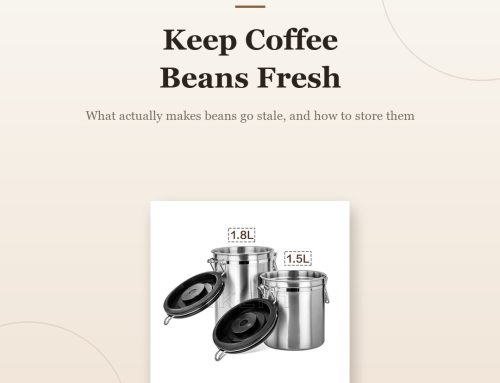
Single sizes rarely work commercially. Buyers tend to structure around use: small capacities for single-origin or trial sizes, mid sizes for everyday beans, and larger capacities for cafes or households buying by the bag.
The important commercial point is headspace. A container much larger than its contents lets air sit above the product, which accelerates staling – and customers who see a partly filled canister read cheapness. Match capacity to realistic fill amounts, then let finish differentiate rather than size alone.
Finish and branding
This is where two products with identical engineering perform very differently in the market.
Brushed or matte steel hides handling marks and suits tools used daily – and it provides an excellent surface for laser marking or engraving.
Spray coating or baked paint allows specific colours, including matching a brand colour across an entire range, so a grinder, a pitcher and a canister read as one family. The trade-off is durability on edges and high points; worth deciding where coated surfaces are acceptable and where bare steel should stay.
Printing or pad printing enables multi-colour artwork on coated finishes but wears fastest where hands repeatedly touch. Place artwork away from grip zones.
MOQs, samples and realistic timelines
Standard specifications with existing tooling carry lower minimums and shorter lead times. Each custom element adds stages – sample build, approval, tooling if truly new, production slot, and freight – and none of those compress much.
The reliable sequence: write the specification (material, gasket type, capacity set, finish, branding method), request samples built exactly to it, then test. Practical tests worth running on samples: seal integrity by water submersion, lid feel one-handed, drop test onto a hard floor, and a wipe-down with common kitchen cleaners to check the finish.
Those four tests cost almost nothing and catch almost every problem that later becomes a complaint – specifically leaks, awkward lids, chipped finishes and faded branding.
Documentation worth requesting
Ask for material declarations per batch and food-contact documentation for the gasket material, not only for the metal. Ask what finish and printing method is used, so care instructions can be written accurately. And ask how replacements are handled for defects – that answer predicts the working relationship better than any sample will.
If this is your first sourcing round in this category, it is worth reading what buyers actually check before shortlisting a supplier, and how the same decisions play out when the destination is online rather than shelf, covered in notes on containers for e-commerce.
Frequently asked questions
What is the realistic minimum order for a custom canister?
It depends on how much is custom. Existing specifications generally require far lower minimums than a genuinely new shape needing new tooling. Sharing target quantities up front usually surfaces workable options for a first run.
Should I choose an uncoated interior?
Usually yes. Uncoated food-grade stainless avoids having to certify an additional coating for long-term contact, which simplifies both compliance and the conversation with downstream retailers.
How long does sampling take?
Samples built to an existing specification can be ready relatively quickly; new finishes or printed artwork add verification time. Plan for two rounds – the first to test function, the second to approve finish and branding – because changes after the first are normal.
Starting an OEM storage range


Browse the full Ikentcoffee Canister Container Coffee Bean Stainless Steel range for sizes, finishes and OEM options.
Let’s Build Something Together
The coffee world keeps demanding quality, functional accessories. Partner with iKentcoffee to offer tools that perform and represent your brand proudly. From manual coffee grinders, espresso tampers and coffee canisters to milk pitchers and full coffee sets — we provide OEM & ODM solutions with low MOQ and stable supply.
👉 Contact us today to discuss wholesale, customization, or to request a sample.
💭 Jiangmen Aika Houseware Co., LTD
💭 Jiangmen Zhenhua Hardware & Plastic Factory
We look forward to the opportunity to collaborate with you!
WhatsApp: +86 13426845305
E-mail: kaelyn@ikentcoffee.com
Website: www.ikentcoffee.com
Leave A Comment