
Milk is the ingredient most likely to undo an otherwise decent espresso, and the pitcher is the tool that decides whether it goes well. Two people can steam identical milk in identical volumes and produce completely different results, and the difference is usually the jug: its shape teaches your hand a particular way of pouring, for better or worse.

None of this requires expensive equipment. It requires a jug whose shape suits the drink you actually make, sized to the cup you actually use, and balanced well enough that your wrist is not fighting it.
Spout shape determines what you can draw
The spout is the whole personality of a pitcher. A sharp, narrow, pointed spout concentrates flow into a thin controllable ribbon, which is what allows fine lines, rosettas and layered detail. A rounder, wider spout releases milk faster and in a softer stream, which suits hearts and tulips and is far more forgiving while learning.
Neither is better in the abstract. If somebody mostly drinks flat white or wants to learn patterns, a pointed spout gives room to grow. If somebody mostly pours lattes for friends, a rounder spout makes every pour easier and there is little reason to fight it.
The other half of the spout question is depth. A deeper spout lets you bring the jug closer to the surface before milk breaks through, which is how you get contrast in a pattern rather than a uniform brown field.
Size the jug to the cup, not to your ambition
Over-sizing is the most common mistake. Steaming 600 ml of milk to make one 180 ml drink forces you to stretch far more milk than you need, and excess volume sits and separates while you work – resulting in foam that has already begun to stiffen before the pour begins.
Practical starting points: 350 ml comfortably handles a single latte or two flat whites; 600 ml suits a mug-sized drink or two cappuccinos; anything above that belongs to a bar doing volume. If you are buying one jug, choose for the drink you make most often and accept that occasionally you will steam two rounds.
Fill level matters too. Milk roughly doubles as it is aerated, so start around a third to a half full – enough to submerge the steam tip properly, not enough to overflow.
Why stainless, why not glass
A pitcher spends its life being filled with hot liquid, dropped into a sink, knocked against a group head and stacked. Stainless handles all of it. It retains heat long enough to pour without rushing, it conducts heat in a way that lets a careful cook feel temperature through the metal, and it does not shatter when it slips on a wet bench.
Glass jugs have one real advantage – you can see how much milk is left – and several disadvantages that matter more in daily use: heat loss, fragility, and no reliable way to judge temperature by touch. They suit a home setup where the jug is handled gently; they do not suit a bar.
Handle and balance are not cosmetic
Pick up a jug and hold it out. Most of the weight should sit directly over your palm, not pulling forward toward the spout. A pitcher that is balanced works with your wrist; one that is not makes every pour feel heavier than it should, and over a busy morning that is genuinely tiring.
Look at how the handle is attached. Smooth, fully welded joins have no place for milk to collect and no sharp edge to bite during a busy service. And check that a hand fits comfortably through the handle – including a hand that is wet.
Matching the jug to the milk you steam
Dairy is forgiving and predictable, which is why most advice implicitly assumes it. Plant milks vary enormously by brand and base, and some separate or resist foaming in ways that punish the wrong technique: lower starting temperature, gentle aeration early, and stop before it gets hot. If you regularly steam alternatives, a jug with a slightly wider spout tends to be more forgiving of the foam structure you end up with.
Pour technique is worth keeping separate from equipment, though. Our notes on espresso with steamed milk cover texture and temperature in detail, because the best-designed jug cannot rescue milk that was aerated badly.
Care and replacement
Rinse immediately after pouring – dried milk is dramatically harder to remove than fresh milk. Wash with warm water and mild detergent, avoid abrasive scouring keep the interior surface smooth, since scratches collect residue. If the jug will be used for service rather than home use, check that the handle weld still looks clean every so often; that joint is the first place fatigue shows.
Frequently asked questions
What size pitcher for home use?
350 ml covers a latte or two flat whites and is easier to texture correctly than anything larger. Bigger jugs tempt you to steam more milk than the drink needs, which is the most common source of stiff, separated foam.
Do I need a pointed spout for latte art?
It helps for detail work, but it is not a prerequisite. A rounder spout makes hearts and simple tulips easy and is much more forgiving. Many people learn jugs with a moderate spout first and move to something sharper once the basic pour is consistent.
Does the finish – mirror, brushed or coloured – matter?
Not for performance. Coloured and coated finishes make the jug easier to identify on a shared bench and let it match other tools, while a plain steel interior is what touches the milk. Choose on looks and durability, not brewing effect.
Pitchers for different pour styles
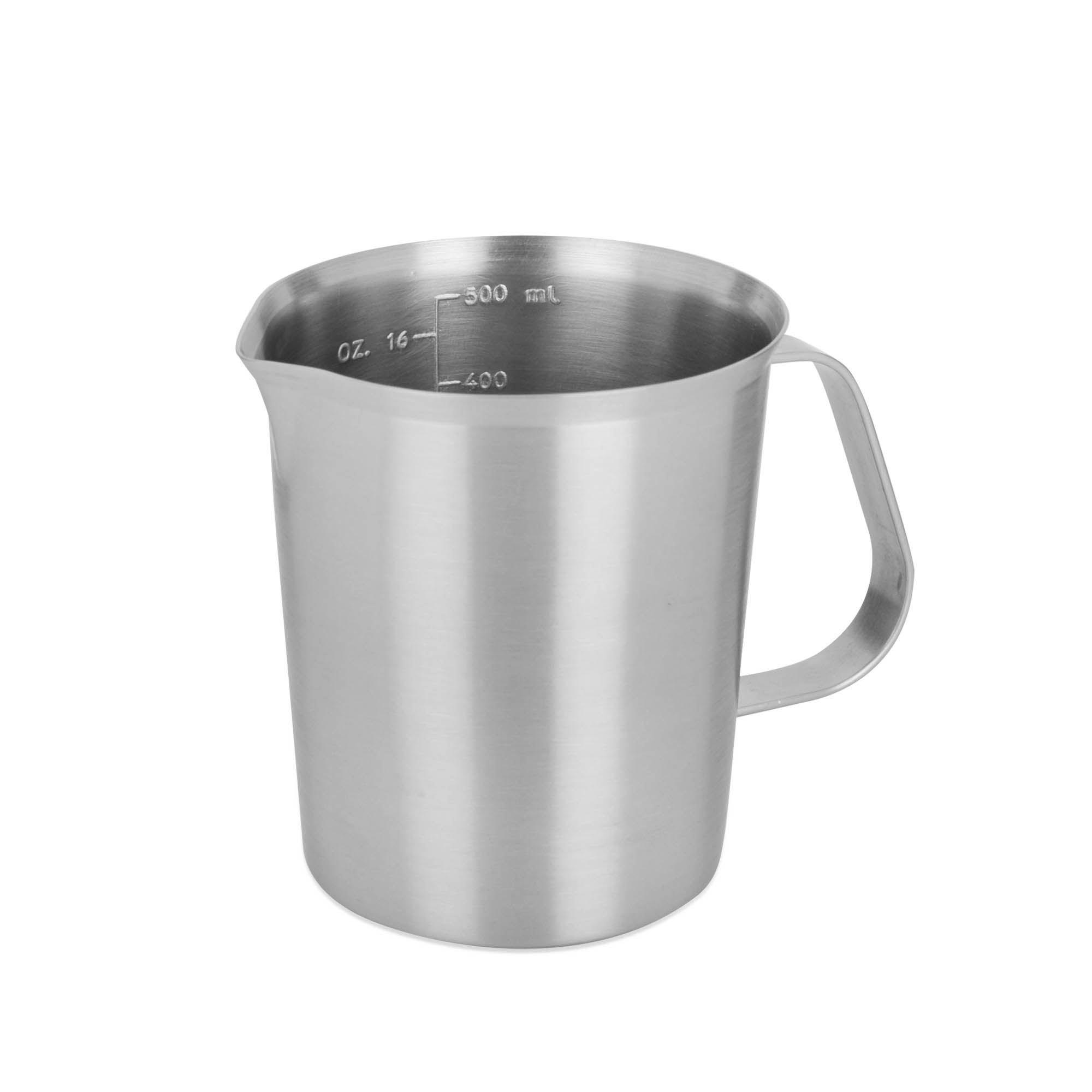


Browse the full Ikentcoffee Milk Pitcher Jug Stainless Steel range for sizes, finishes and OEM options.
Let’s Build Something Together
The coffee world keeps demanding quality, functional accessories. Partner with iKentcoffee to offer tools that perform and represent your brand proudly. From manual coffee grinders, espresso tampers and coffee canisters to milk pitchers and full coffee sets — we provide OEM & ODM solutions with low MOQ and stable supply.
👉 Contact us today to discuss wholesale, customization, or to request a sample.
💭 Jiangmen Aika Houseware Co., LTD
💭 Jiangmen Zhenhua Hardware & Plastic Factory
We look forward to the opportunity to collaborate with you!
WhatsApp: +86 13426845305
E-mail: kaelyn@ikentcoffee.com
Website: www.ikentcoffee.com
Leave A Comment