
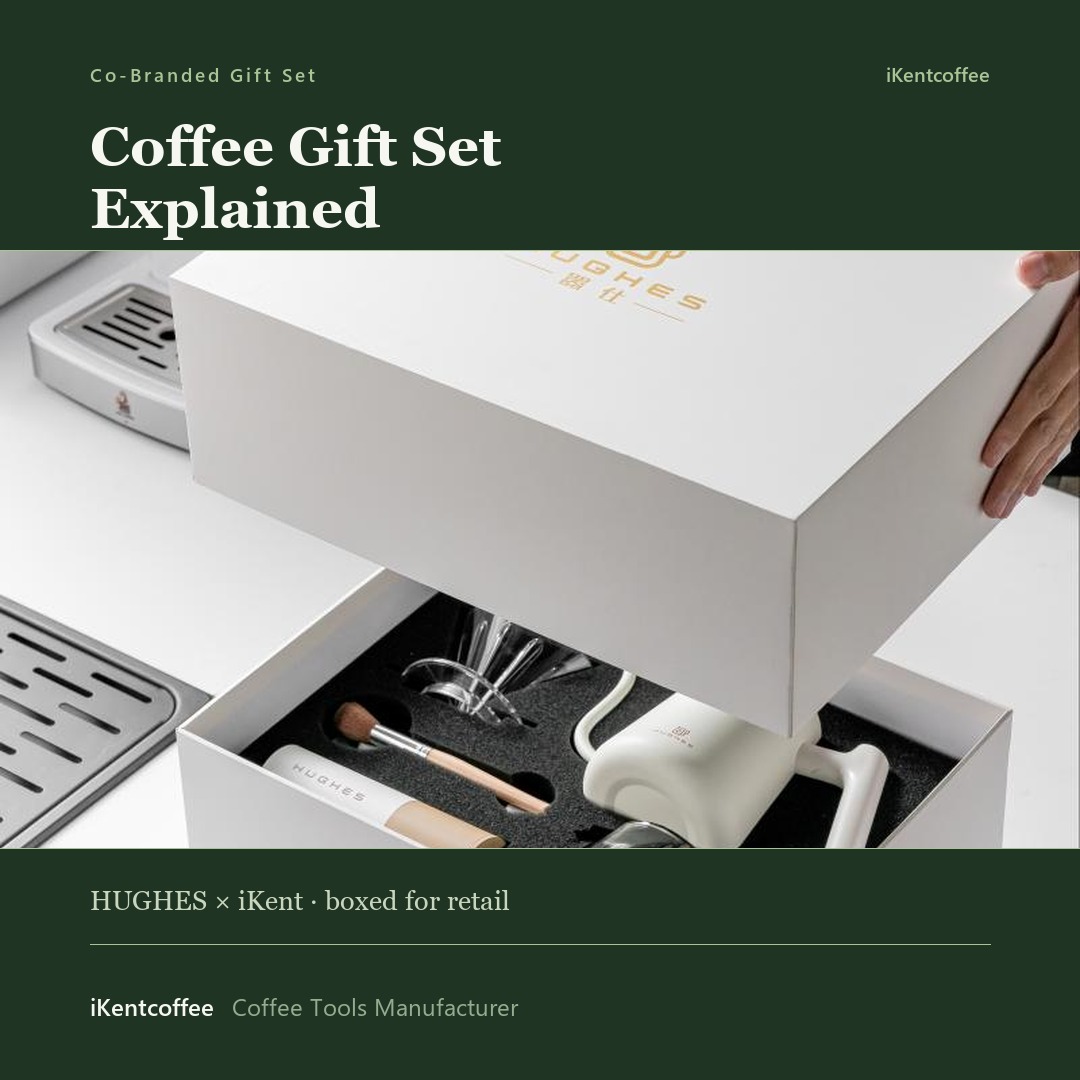
A co-branded coffee gift set is one retail SKU assembled from two manufacturers’ catalogues: the brewing hardware from one brand, the tools and the packing from the other, sold under both names. The HUGHES × iKent box follows exactly that model – a gooseneck kettle, a glass brewer, a stainless canister and a cleaning brush inside a white, foil-blocked gift box. Item CGS-001, MOQ 100 pcs per model, 30 days standard production or 45 days once the packaging is customised.
What is inside the HUGHES × iKent gift set?
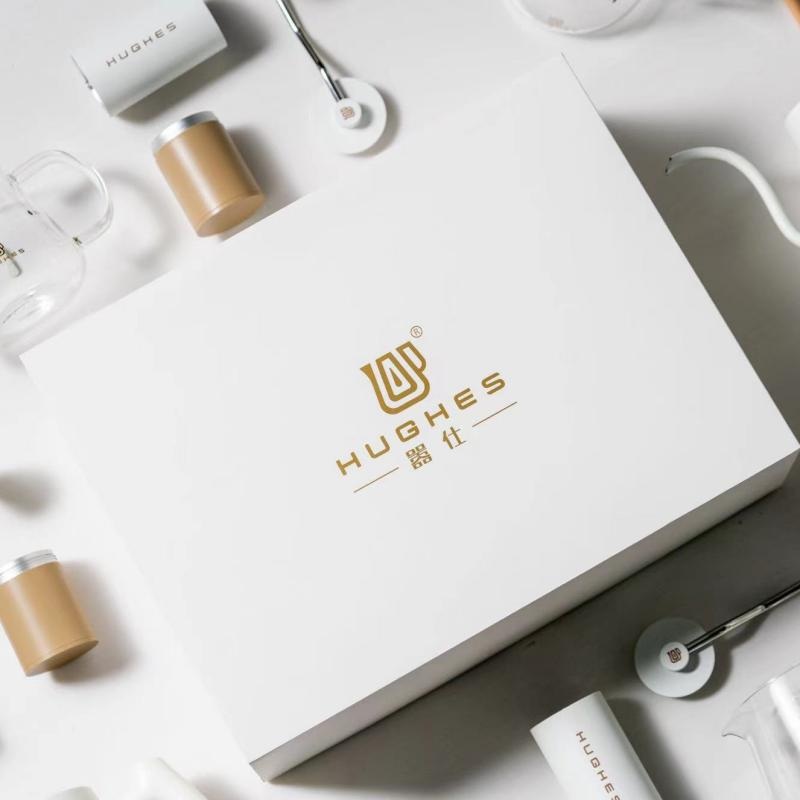
One pour-over ritual, boxed: a gooseneck kettle with a wood handle, a glass brewer with a matching carafe, a stainless steel canister for beans or powder, a wooden-handled cleaning brush, and a glass cup. Everything sits in a die-cut insert so nothing shifts in transit, and the outer box is rigid board with the HUGHES wordmark blocked in gold foil on the lid.
The material list behind that list is short and worth reading twice: stainless steel, glass and wood. Three materials means three separate finishing processes and three separate packing steps, which is why a gift set takes longer to sample than the single tool it is built around. A tamper or a funnel is one SKU on one bench; a set is five SKUs that have to arrive in one box, in the same finish, on the same day.
The box carries the partner’s name; the product listing carries the manufacturer’s. That split is normal in this kind of project: one company machines, finishes and exports, the other lends the name a buyer recognises on the shelf.
Why co-brand a set instead of selling it white-label?
Because a gift is bought on the strength of a name, and two names reach two audiences at the moment of purchase. A plain box asks the buyer to trust the contents; a named box asks them to trust the name they already know. In the HUGHES case that name carries pour-over credibility – the brand was launched in 2021 by a Jiangmen hand-pour manufacturer that had spent years building other people’s kettles, and its vacuum double-wall kettle took a Red Dot award in 2024.
For the retailer the arithmetic is simpler than the branding. A set is one barcode, one listing and one carton to ship; the same tools sold loose are three listings, three return policies and three chances of being out of stock on the day the gift shopper arrives. That is why gift sets outsell the parts in Q4 even when the parts are cheaper per unit.
The one decision that has to be made before artwork goes to print is logo hierarchy. In a co-branded box the lid usually carries the host brand, and the partner appears on the insert card, the belly band or the back panel. Once the foil block and the insert die are cut, changing that hierarchy means paying for both again – so settle it in writing while the artwork is still a PDF.
What does the packaging add to the cost of a gift set?
The box, not the tools, is usually the binding constraint. Products inside a set start at MOQ 100 pcs per model; a printed retail box starts at 500 pcs. That gap of five is the number to plan around, because it decides whether your first run looks like a gift set or like stock in a plain box.
Work through a first order of 200 sets: the tools clear MOQ comfortably, but a printed box does not, so the run ships in a white or plain gift box and the branded box waits for the order that reaches 500. Boxes do not expire, which is why the usual route is to print at 500 and carry the balance into the second run rather than pay a surcharge for a short print run.
The insert is the part buyers underestimate. A die-cut foam insert is cut from a physical sample first, because the pockets have to match the kettle spout, the carafe foot and the brush handle to within a couple of millimetres. Change one item in the box after the insert is approved, and you need a new insert die, a new carton specification and a new drop test – the tools did not change, but the packing did.
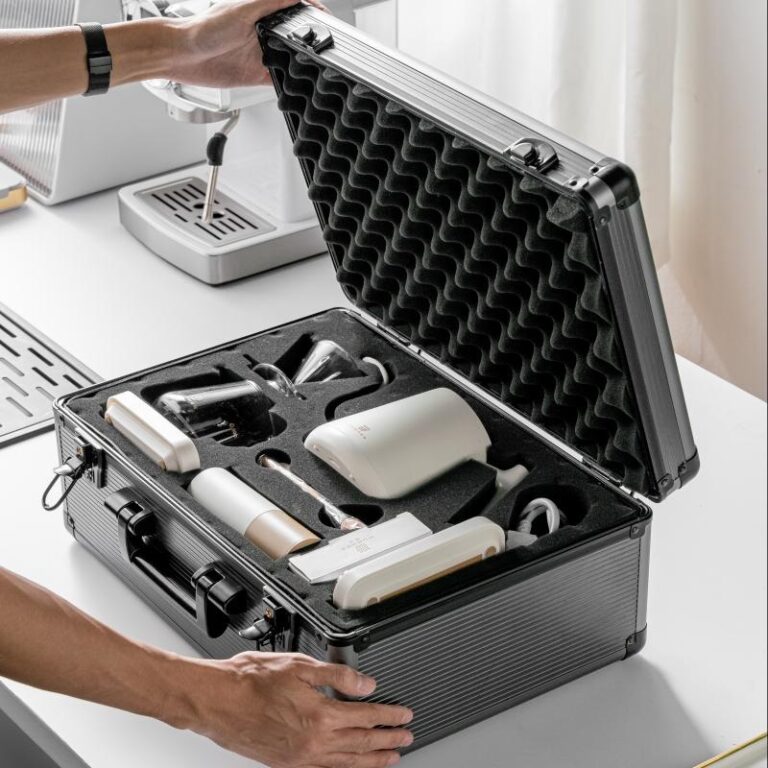
A hard case is the other end of the same decision. An aluminium flight case with a foam insert survives being checked in as luggage and reads as a kit rather than a present, which suits corporate gifting and competition prizes. It also adds weight and volume to every set, so it belongs on air freight only when the order is small enough that the per-unit freight does not swallow the margin.
What MOQ and lead times should you plan for?
MOQ is 100 pcs per model and does not rise when a logo is added. Sampling of existing models runs 3–5 working days; production is 30 days for a standard order and 45 days once a custom logo, colour or packaging is in scope. A gift set with a printed box and a new insert sits at the 45-day end, not the 30-day end.
| Item | Specification |
|---|---|
| Item number | CGS-001 (coffee gift set) |
| Materials in the set | 304 stainless steel, glass, wood |
| Colour | Black, silver, or any Pantone colour matched |
| Finish options | Mirror, matt, frosting, painting, titanium, PVD |
| Logo | Laser marking or silkscreen |
| Packaging | White box / gift box / carton; printed retail box from 500 pcs |
| MOQ | 100 pcs per model, including custom logo versions |
| Sample lead time | 3–5 working days for existing models |
| Production lead time | 30 days standard / 45 days with custom logo, colour or packaging |
| Testing | Conforms to FDA (21 CFR) and LFGB food-contact requirements; third-party test report available for the tested SKU |
| Shipping | Express, air or sea; door-to-door; Amazon FBA with FNSKU labelling |
Both plants behind the numbers have been in coffee tools for 15 years – one forms and polishes 304 stainless steel, the other machines wooden handles, springs and burrs. That split is what lets a set mix steel, wood and glass without the box becoming a sourcing project of its own.
Can you build your own set from a mixed catalogue?
Yes, and a gift set is the cheapest way to test a range because of how MOQ is counted. MOQ applies per model, not per order. A set of five items at 100 sets therefore clears 100 pcs on every line at once – one purchase order, five models qualified, and a range you can expand later without renegotiating anything.
What you cannot mix freely is the finish. Mirror, matt, frosting, painting, titanium and PVD are six different processes, and a set that puts a painted kettle next to a mirror-polished canister reads as assembled rather than designed. Pick one finish for the whole box, and let the colour do the differentiating: black and silver are standard, and any Pantone colour can be matched on a custom run.
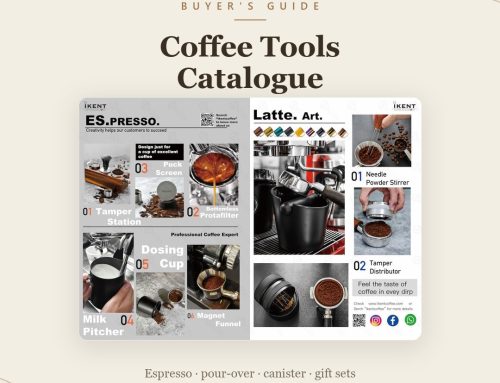
The logo process follows the same logic as the finish. Laser marking is the default on bare stainless steel; on a deep painted surface the laser burns through the coating and shows the steel underneath as a lighter mark, so dark colours are silkscreened instead, or marked before coating. That adds a step to the first run. Finishes, logo processes and box artwork are covered in more depth in coffee tools branding, and the wider range that a set can be drawn from is mapped in the coffee tools catalogue.
How do you ship gift sets to Amazon FBA without damage?
Treat the retail box as the unit, not the outer carton. A dented gift box is unsellable even when the tool inside is perfect, so the outer carton and the insert do the protecting: FNSKU labelling on each retail unit, carton marking on the outside, and a delivery appointment booked with the warehouse. Orders move by express, air or sea, door-to-door.
Ask for the drop test before the first shipment rather than after the first complaint. Drops are tested and the report can be shared, which matters more for a gift set than for a bare tool – the box is what the customer keeps and photographs, and a corner that has been crushed in transit is the review you get.
Frequently asked questions
Do both brand names appear on the box?
In a co-branded set, yes – but at different levels. The host brand usually takes the lid or the front panel, and the manufacturing partner appears on the insert card, the belly band or the back panel with the material and care information. Fix that hierarchy before the foil block and the insert die are cut.
Can I put my own logo on a co-branded set?
Yes. Logo is laser marking or silkscreen on the tools, and the box artwork is customisable on a printed run. MOQ stays at 100 pcs per model for the products; the printed retail box starts at 500 pcs.
Is the gift box included at MOQ 100?
A white or plain gift box is. A printed retail box with your artwork is a 500 pcs minimum, so a first order of 100–300 sets normally ships in the plain box, with the printed box following on the larger run.
What happens if I change the contents after the sample is approved?
The insert has to be re-cut and the carton re-specified, because the pockets are cut to the exact footprint of each item. The tools themselves do not change; the packing and the drop test do, so budget another sample round before production.
What certification comes with a gift set?
The food-contact parts conform to FDA (21 CFR) and LFGB requirements, and a third-party test report is available for the tested SKU – reports are issued per SKU and batch, not as a blanket claim for the whole range. A factory audit report can be provided on request.
Gift sets and the tools inside them

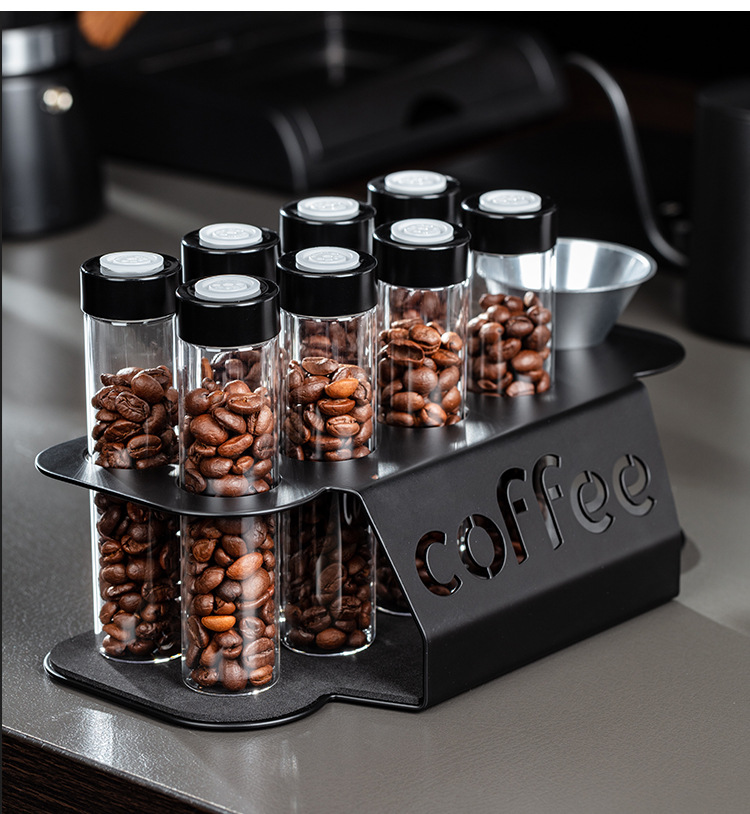

Browse the full gift box set range for contents, finishes and packaging options.
Let’s Build Something Together
The coffee world keeps demanding quality, functional accessories. Partner with iKentcoffee to offer tools that perform and represent your brand proudly. From manual coffee grinders, espresso tampers and coffee canisters to milk pitchers and full coffee sets — we provide OEM & ODM solutions with low MOQ and stable supply.
👉 Contact us today to discuss wholesale, customization, or to request a sample.
💭 Jiangmen Aika Houseware Co., LTD
💭 Jiangmen Zhenhua Hardware & Plastic Factory
We look forward to the opportunity to collaborate with you!
WhatsApp: +86 13426845305
E-mail: kaelyn@ikentcoffee.com
Website: www.ikentcoffee.com
Leave A Comment