
Coffee starts losing flavour the moment it leaves the roaster. To keep beans fresh, store them whole in an airtight, opaque container at room temperature, away from light, heat and moisture. Ground coffee gives up most of its aroma within 15–30 minutes; whole beans, stored properly, hold their character for about two to four weeks after roasting.
Almost everyone who sells or serves coffee has had the same frustration: a bag that smelled incredible on day three tastes flat by day twenty. Nothing went wrong with the roast. What went wrong is what happened after the bag was opened.
Freshness is not a single switch that flips. It is a slow leak, and four things make the leak faster: oxygen, light, moisture and heat. Understanding those four explains nearly every piece of storage advice that follows.
Why coffee goes stale in the first place
Roasting transforms a dense green seed into a porous, brittle structure full of trapped carbon dioxide and several hundred volatile aromatic compounds. Those compounds are the smell you get when you open a fresh bag — and they are also the first thing to disappear.
Two processes run at the same time. Carbon dioxide slowly escapes, carrying aroma with it, while oxygen moves in and oxidises the delicate oils on and inside the bean. Oxidation is what turns bright, sweet, fruity coffee into something that tastes like cardboard. Grinding accelerates both, because it multiplies the surface area exposed to air by orders of magnitude.
This is also why freshly roasted beans need a short rest before brewing. For the first few days the CO2 release is vigorous enough to interfere with extraction. Most roasters find the sweet spot somewhere between day four and day twenty-one.
The four enemies of freshness
Oxygen
The main culprit. Every time a bag or canister is opened, fresh oxygen enters. A good container limits how much gets in and how often.
Light
UV light degrades the oils on the bean surface and speeds up staling. This is the reason clear storage jars look attractive on a counter but perform poorly — unless they live inside a cupboard.
Moisture
Coffee is hygroscopic: it pulls water out of the air. Absorbed moisture dulls flavour, encourages mould over time and makes the grind behave unpredictably. Humid climates make this noticeably worse.
Heat
Warmth speeds up every chemical reaction above, including the loss of aroma. Storing beans above the oven, next to a window or on top of an espresso machine are the classic mistakes.
Whole bean or ground?
Whole bean, almost always. Grinding is the single largest step-change in how fast coffee goes stale, which is why the usual advice is to buy whole and grind per brew. If you are deciding between the two for a retail line or a café workflow, we went into the trade-offs in more detail in whole bean vs ground coffee.
The practical exception is portioned, sealed single-serve packs: they stale fast once opened, but because each pack is only opened once, the total exposure is lower than repeatedly opening a large bag.
What actually makes a coffee container work
Marketing copy talks about features. What matters in practice comes down to five things:
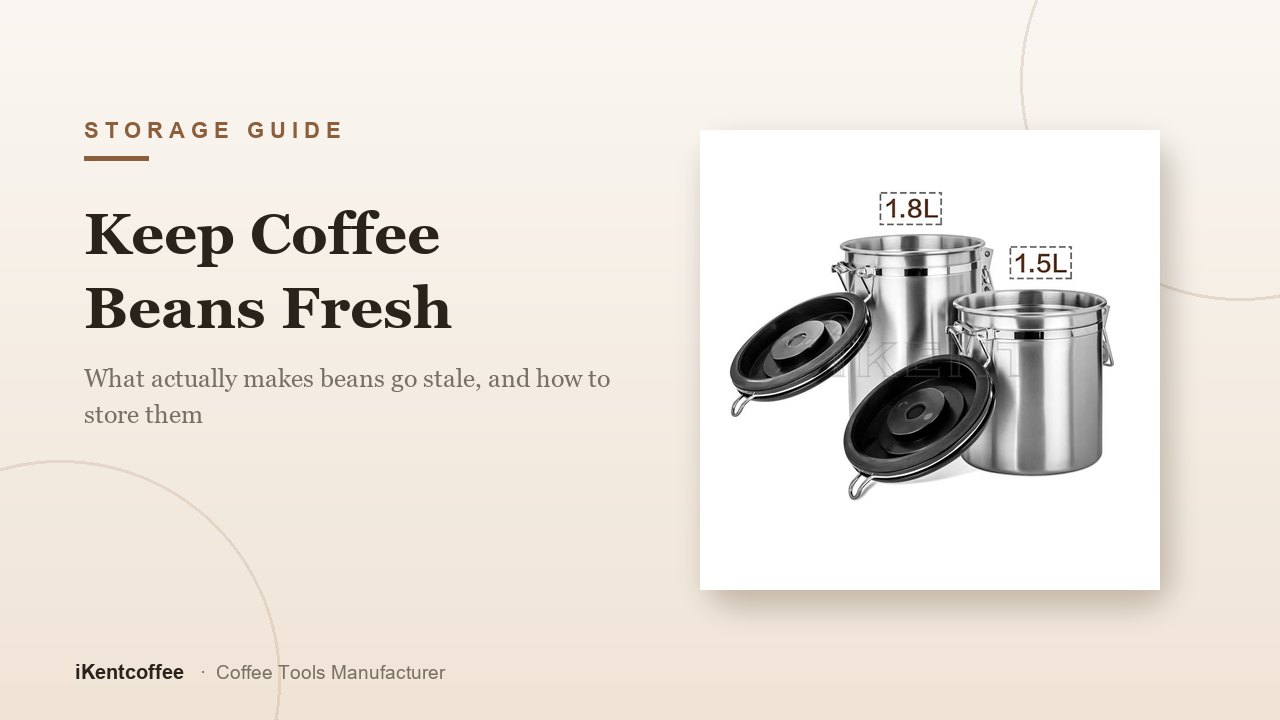
- A genuine seal. A lid that presses a food-grade gasket against a rigid rim, so air exchange is close to zero when closed.
- A one-way CO2 valve. Freshly roasted beans keep releasing gas for days. A valve lets that gas out without letting oxygen in — useful for anyone filling containers soon after roast.
- Opaque walls. Stainless steel or opaque-coated bodies block light entirely; clear glass only works if it stays in the dark.
- A date tracker. The single highest-value habit in coffee storage is knowing the roast date. A dial on the lid makes that easy to record without a marker or a sticker.
- A working size. A half-empty container holds a half-empty volume of air. Choosing a capacity that matches actual throughput matters more than most buyers expect.
Those five criteria are the same ones we design against when developing storage for coffee brands — though they apply regardless of whose container you end up buying.
Should you freeze coffee beans?
For everyday use, no. Every trip in and out of the freezer produces condensation on the beans, and moisture is exactly what you are trying to avoid.
Freezing does make sense for long-term storage of larger volumes, provided the coffee is split into sealed portion-sized packs, frozen once, and thawed unopened at room temperature before use. For a café or a roaster holding back a limited lot, this is a legitimate technique. For a household bag opened daily, it is not.
How long do coffee beans actually last?
- Whole bean, sealed, room temperature: best within 2–4 weeks of roast; drinkable for 2–3 months.
- Ground coffee: noticeably flatter within a week, sometimes within days.
- Unopened, valve-packed: often good for 3–6 months depending on the roast and the packaging.
- Frozen in sealed portions: can hold quality for several months beyond that.
Numbers like these are guidelines, not guarantees. Roast date, roast level and how the coffee has been handled since all shift the window.
A routine that keeps beans fresh
- Buy in quantities you will finish in two to three weeks.
- Check the roast date, not just the best-before date.
- Keep beans whole; grind only what you are about to brew.
- Store in an airtight, opaque container in a cool cupboard — not the fridge, not above the machine.
- Close the lid immediately after every use.
- Set the date when you open a new batch, so you notice when it is time to reorder.
Frequently asked questions
Does a one-way CO2 valve really make a difference?
Yes, mainly in the first week or two after roasting, when gas release is strongest. It lets pressure escape without drawing outside air in. For coffee that is weeks old and already degassed, its effect is much smaller.
Is stainless steel better than glass?
For light protection, yes — steel blocks light completely, glass does not. Glass also tends to be more fragile in a busy kitchen. Glass is fine if the container lives in a cupboard and the seal is genuinely airtight.
Should coffee be stored in the fridge?
No. A fridge is a humid environment with strong odours, and coffee will absorb both. Room temperature in a sealed, opaque container is better for anything you use weekly.
What size container should I choose?
Match it to how much coffee you go through in about two weeks. Oversized containers hold more air; undersized ones mean constant refilling. For most households that lands in the one-to-two litre range, while cafés usually want several smaller containers rather than one large one.
Storage that keeps beans fresh


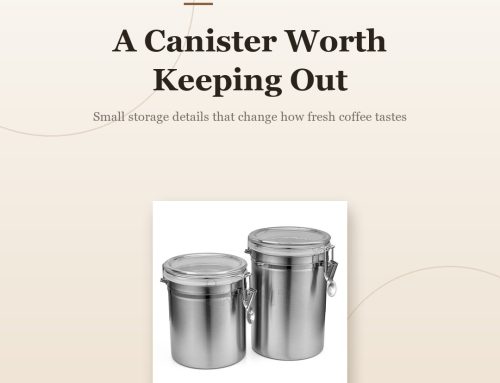
Browse the full Ikentcoffee Canister Container Coffee Bean Stainless Steel range for sizes, finishes and OEM options.
Let’s Build Something Together
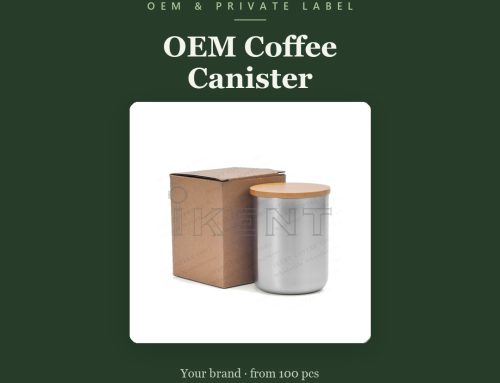
The coffee world keeps demanding quality, functional accessories. Partner with iKentcoffee to offer tools that perform and represent your brand proudly. From manual coffee grinders, espresso tampers and coffee canisters to milk pitchers and full coffee sets — we provide OEM & ODM solutions with low MOQ and stable supply.
👉 Contact us today to discuss wholesale, customization, or to request a sample.
💭 Jiangmen Aika Houseware Co., LTD
💭 Jiangmen Zhenhua Hardware & Plastic Factory
We look forward to the opportunity to collaborate with you!
WhatsApp: +86 13426845305
E-mail: kaelyn@ikentcoffee.com
Website: www.ikentcoffee.com
Leave A Comment